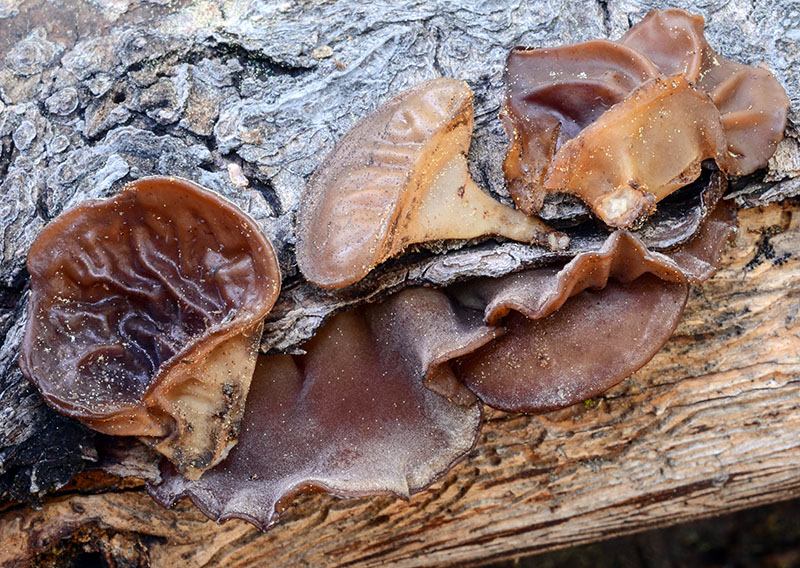
Auricularia americana
Les Champignons des Arbres de l'Est de l'Amérique du Nord: 287. 2003.
Common Name: none
Misapplied names: Auricularia auricula; Auricularia auricula-judae
For description see Barrett.
Not uncommon in montane areas on conifers and hardwoods, much less common in coastal areas; late fall through spring.
 Edible.
Auricularia americana can be distinguished by its ear shape, gelatinous or jellylike flesh, reddish-brown to orange-brown to brown underside (fertile surface), and pallid finely tomentose top. Tremella foliacea is similarly similarly colored, but lacks the ear shape and tomentose upper surface.
Arora, D. (1986). Mushrooms Demystified. Ten Speed Press: Berkeley, CA. 959 p.
Barrett, M.F. (1910). Three Common Species of Auricularia. Mycologia 2(1): 12-18. (PDF)
Boulet, B. (2003). Les Champignons des Arbres de l'Est de l'Amérique du Nord.: 1-727.
Looney, B.P., Birkebak, J.M. & Matheny, P.B. (2013). Systematics of the genus Auricularia with an emphasis on species from the southeastern United States. North American Fungi 8(6): 1-25.
Parmasto, E. & Parmasto, I. (1987). Variation in basidiospores in the Hymenomycetes and its significance to their taxonomy. Bibliotheca Mycologica. 115:1-168.
Wu, F., Yuan, Y., He, S.-H., Bandara, A.R., Hyde, K.D., Malysheva, V.F., Li, D.-W. & Dai, Y.-C. (2015). Global diversity and taxonomy of the Auricularia auricula-judae complex (Auriculariales, Basidiomycota). Mycological Progress 14(10): 95.