
Hebeloma crustuliniforme
Champ. Jura Vosg. 1: 128. 1872.
Common Name: poison pie
Cap 4-9 cm broad, convex at first with inrolled margin, becoming plano-convex with a broad umbo, margin sometimes upturned in age; surface smooth, viscid when moist, cream to buff shading to a buff-brown disc; flesh thick, white; odor of radish, taste bitter.
Gills close, adnate to adnexed, white becoming pale brown, finely serrate, edges with droplets of liquid when young.
Stipe 4-7 cm tall, 0.7-14 cm thick, equal to enlarged at the base, pallid to concolorous with cap, apex pruinose, i.e. covered with fine powdery granules; veil absent; solid; rhizomorphs usually seen at base.
Spores 9-12 x 6-7 µm, elliptical, slightly roughened. Spore print dull brown.
Solitary, gregarious or in arcs and rings. Very common under live oak (Quercus agrifolia) and conifers (especially Monterey pine) fruiting from after the fall rains to late winter; sporadic fruitings are sometimes seen during the summer in watered areas.
 Toxic. The unknown toxins cause a rather severe gastrointestinal syndrome.
Our Hebeloma crustuliniforme represents a complex of species in California, none of which may be the real H. crustuliniforme of Europe. Our most common form is recognized by moderately large fruitbodies with a cream-colored cap with a darker center, dull brown gills with water droplets on the edges when young, a cylindrical white stipe, and growth primarily with live oaks and pines.
Ammirati, J.F., Traquair, J.A. & Horgen, P.A. (1985). Poisonous Mushrooms of the Northern United States and Canada. University of Minnesota Press: Minneapolis, MN. 396 p.
Arora, D. (1986). Mushrooms Demystified. Ten Speed Press: Berkeley, CA. 959 p.
Beker, H.J., Eberhardt, U. & Vesterholt, J. (2016). Hebeloma (Fr.) P. Kumm. Edizioni Tecnografica: Lomazzo, Italy. 1217 p.
Breitenbach, J. & Kränzlin, F. (2000). Fungi of Switzerland. Volume 5: Agarics (3rd Part). Cortinariaceae. Verlag Mykologia: Luzern, Switzerland. 338 p.
Desjardin, D.E., Wood, M.G. & Stevens, F.A. (2015). California Mushrooms: The Comprehensive Identification Guide. Timber Press: Portland, OR. 560 p.
Knudsen, H. & Vesterholt, J. ed. (2008). Funga Nordica: Agaricoid, boletoid and cyphelloid genera. Nordsvamp: Copenhagen, Denmark. 965 p. (PDF)
Knudsen, H. & Vesterholt, J. ed. (2012). Funga Nordica: Agaricoid, boletoid, clavarioid, cyphelloid and gastroid genera. Vol. 2. Nordsvamp: Copenhagen, Denmark. 572 p.
Eberhardt, U. & Beker, H.J. (2015). Decrypting the Hebeloma crustuliniforme complex: European species of Hebeloma section Denudata subsection Denudata (Agaricales). Persoonia 35: 101-147.
Siegel, N. & Schwarz, C. (2016). Mushrooms of the Redwood Coast. Ten Speed Press: Berkeley, CA. 601 p.
Smith, A.H. (1949). Mushrooms in their Natural Habitats. Sawyer's Inc: Portland, OR. 626 p. (PDF)
Vesterholt, J. (2000). Hebeloma crustuliniforme and related species. Field Mycology 1(2): 58-68.
Vesterholt, J. (2005). The Genus Hebeloma (Fungi of Northern Europe, Vol. 3). Danish Mycological Society: Copenhagen, Denmark. 146 p.

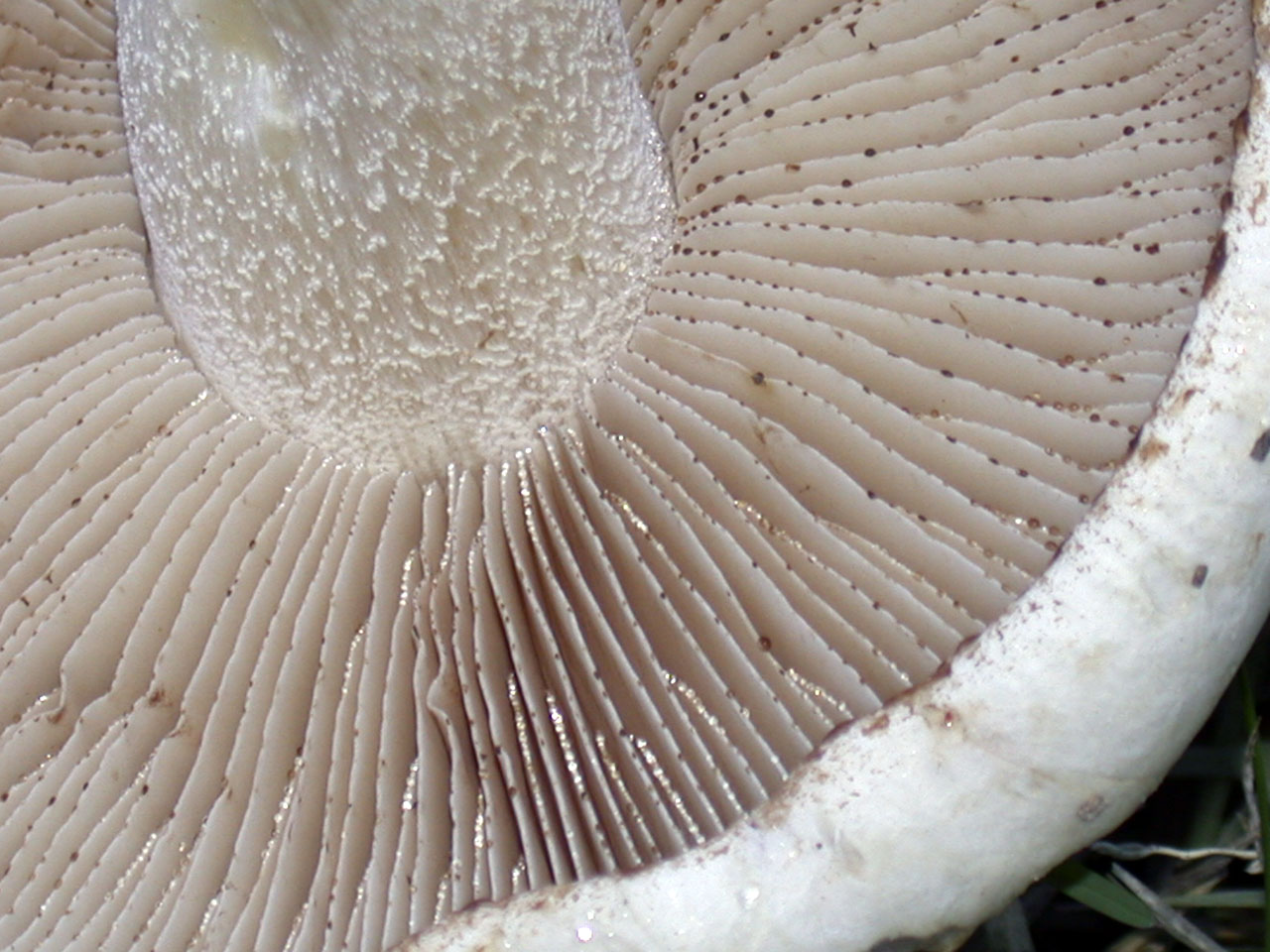 — picture of gill showing the typical liquid droplets


